
Why Does My Garden Hose Keep Kinking? (Fixes That Last)
Your garden hose keeps kinking for one of three reasons: the material is too soft to hold its own shape, the hose has developed a “memory” from being stored in tight coils, or you’re dragging it out while it’s twisted. The fastest fix for a kink that’s happening right now is to walk back toward the spigot, give the hose a firm counter-clockwise twist to unwind the loop, and let the water pressure re-inflate it straight. To stop kinks for good, store the hose in large loops or a figure-8 rather than tight circles, keep it out of direct all-day sun, and match the material to how hard you use it.
The rest of this guide helps you figure out which of those three causes is yours, so you fix the actual problem instead of buying a new hose you didn’t need. We’re a garden site, not a hose brand, so there’s no product we’re steering you toward here.
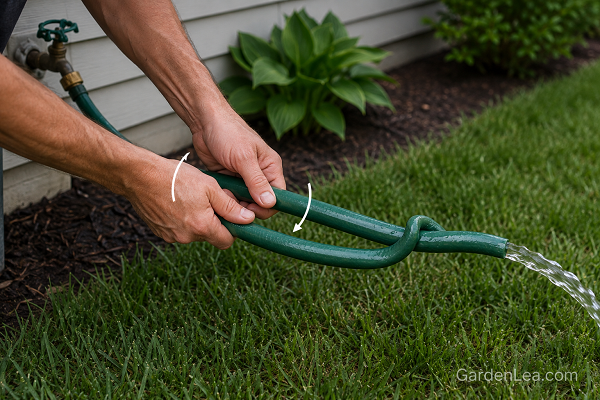
The 30-second fix for a kink happening right now
Before anything else, get the water flowing again:
- Follow the hose back from the kink toward the spigot. A kink almost always sits just downstream of a twist further up the line.
- Grab the hose a foot before the kink and rotate it counter-clockwise while you gently pull it straight. You’re untwisting the loop that folded on itself, not forcing the fold open.
- Turn the water pressure up for a few seconds. Once the wall re-inflates, the hose wants to hold a straight line again.
- Walk the whole length out flat before you keep working. A kink you popped open will just reappear if the twist behind it is still there.
That clears the symptom. Now let’s find the cause so it stops coming back.
Why hoses kink: material, memory, and drag
A kink is not random. It’s a fold that forms where the hose wall is too weak to resist a bend sharper than the tube can take. Three things push a hose past that point.
- Material. A thin, soft wall folds easily. A thicker, reinforced, or more elastic wall springs back instead of creasing. This is the single biggest factor, and it’s why the same watering habits kink a cheap hose and never touch a good one.
- Memory. Coil a hose tight and leave it that way for weeks, especially warm weeks, and the wall “learns” that curl. Roll it out and it fights back into loops. Those loops are where the next kink starts. On an old hose, memory can become permanent.
- Drag. Every time you yank a hose around a corner or a pot, you put a twist into it. Twists don’t lie flat; they stand up as loops, and loops fold into kinks the moment pressure hits them. Heat makes all of this worse: a hose baking in the sun goes softer and creases more easily.
Find your cause: a 3-question self-test
Answer these three and you’ll know which fix is yours. This is the step every hose-brand blog skips, because they’d rather you conclude the answer is a new hose.
1. Where does it kink?
- Always near the spigot or nozzle → the twist is being introduced at the connection. You need a swivel/bend restrictor at the fitting and a slower, straighter pull. (Fixable without replacing anything.)
- In the same one or two spots along the middle every time → that’s set-in memory. Try the sun-and-pressure reset below; if it won’t hold, the wall is fatigued.
- Randomly, all over → the material is too soft for how you use it. Storage habits will help; a material upgrade helps more.
2. Is the hose new or old?
- New (under a season) and already kinking → it’s not memory yet. It’s either how you’re storing/dragging it, or you bought a wall that’s too thin. Fix habits first.
- A few seasons old → memory and material fatigue are the likely culprits. Resets get harder to hold as a hose ages.
3. How is it stored between uses?
- Tight coils, a bucket, or a pile on the ground → this is manufacturing kinks for you. Move to large loops or a reel (see next section).
- A reel or wide wall hook, out of the sun → storage isn’t your problem; look back at material and drag.
Most people land on either “storage” or “material.” Both are fixable. Only one costs money.
Storage that actually prevents kinks
How you put a hose away decides how it behaves the next day. Two methods work; one costs nothing.
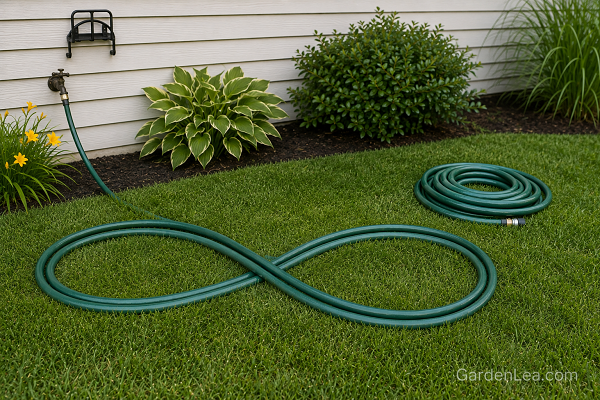
The figure-8 coil (no equipment)
The reason ordinary coiling causes kinks is that every loop adds a half-twist in the same direction, and those twists stack up. A figure-8 cancels them out.
- Drain the hose and lay it out straight.
- Hold the spigot end in one hand. With the other, lay the hose down in a loop, then bring the next loop over the top in the opposite direction so the two loops form a figure-8, not a stacked circle.
- Keep alternating directions the whole length. Each reversal untwists the last loop.
- Tie the bundle loosely at the crossover point, or hang it over a wide hook.
Because each loop twists opposite to the one before, the hose comes off straight instead of springing into memory loops.
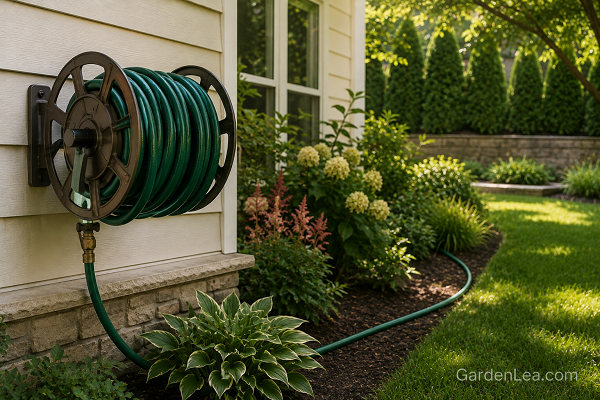
Large loops on a reel or wide hook
If you’d rather not hand-coil, the rule is big and round beats small and tight. A reel, a wall-mounted holder, or even a five-gallon bucket to loop over all work, as long as the loops stay wide. Wide loops don’t crease the wall; tight ones train it to fold.
Two habits multiply the payoff:
- Store it out of direct all-day sun. UV and heat soften and age the wall, which turns into permanent kinks and cracks. Shade roughly doubles a hose’s working life in a hot climate.
- Stretch the hose fully before each use and let a twist “unwind” itself before you turn the water on. Watering with a twisted hose is the number-one way to create a kink from scratch.
Which hose materials resist kinking
If you’ve fixed your habits and a hose still kinks, the wall is the problem. Here’s how the common materials compare. We haven’t lab-tested these ourselves; this reflects the consistent consensus across manufacturer specs and independent reviews, framed by material type rather than brand.
| Material | Kink tendency | Weight | Typical lifespan | Best for |
|---|---|---|---|---|
| Vinyl (PVC), single-layer | High, folds under light pressure | Very light | ~1-2 seasons | Occasional light watering, tight budgets |
| Reinforced vinyl (mesh layer) | Medium | Light-medium | ~2-4 seasons | General home use |
| Rubber | Low, springs back, handles pressure | Heavy | Many seasons | Heavy use, hot water, hard yards |
| Hybrid polymer | Very low, stays pliable in heat and cold | Medium (light for its strength) | Many seasons | All-round use, cold mornings |
| Expandable | Very low when in good shape; can fail suddenly | Very light | Varies widely | Storage-limited spaces, light use |
A few honest caveats the material names don’t tell you:
- “Kink-free” and “kink-proof” on the label are marketing, not a guarantee. They mean kink-resistant under normal use. Any hose will kink if you store it in tight coils and drag it twisted. Good material raises the threshold; it doesn’t remove it.
- Bend restrictors at the fittings matter as much as the wall. Those little collars where the hose meets the brass are where most kinks start, regardless of material.
- Cold changes everything. Standard vinyl and even rubber stiffen on a cold morning, and a stiff hose creases where a warm one would flex. If you water year-round in a cold climate, flexibility across temperatures matters more than the headline material.
If you’re weighing the trendy option, our take on whether expandable garden hoses are worth it covers where they shine and where they fail. And if you’re not sure your hose diameter is even right for your water pressure, the garden hose size guide explains why a hose that’s too narrow feels stiffer and kinks more.
When to stop fighting and replace the hose
Here’s the part a brand blog won’t say plainly, because their answer is always “buy ours.” Sometimes the hose is genuinely done, and no technique will save it. Replace it when:
- The same spot kinks every single time even after a sun-and-pressure reset. The wall has a permanent crease and a weakened memory there. That spot is also where it will eventually split.
- The wall has gone stiff, chalky, or cracked from UV. Sun-baked material doesn’t recover.
- It kinks and leaks at the same fold. A crease that’s started to seep is failing structurally. (If it’s leaking somewhere else, that’s often a cheap fix, see how to fix a leaky garden hose before you throw it out.)
- It’s a thin single-layer vinyl hose you fight with daily. At that point you’re spending more effort than a better-walled hose costs to own.
If it’s none of those, you almost certainly don’t need a new hose. You need a figure-8 coil and shade.
The sun-and-pressure reset (with the safety caveat)
For a hose with set-in memory that isn’t cracked, this often buys another season: lay it out straight in the sun for a couple of hours with the water turned on to full pressure. Warmth softens the wall and pressure re-inflates it, and the memory loops relax out.
One real caution: don’t leave a pressurized hose baking unattended for hours or overnight. Heat plus trapped pressure stresses old fittings and worn walls. Do it while you’re home and gardening, and shut the water off when you’re done.
FAQ
Does hot water or leaving the hose in the sun really fix kinks?
It helps for memory kinks, not for cracked or fatigued hoses. Warmth makes the wall more pliable so water pressure can push the fold back out. It won’t fix a permanent crease, and you shouldn’t leave a pressurized hose in the sun unattended.
Do “kink-free” and “kink-proof” hose claims mean anything?
They mean kink-resistant, not kink-immune. A better wall and bend restrictors raise the point at which the hose folds, but store any hose in tight coils and drag it twisted and it will still kink. Treat the label as “harder to kink,” not “impossible.”
Why does my brand-new hose already kink?
A new hose hasn’t developed memory yet, so the cause is almost always how you’re using it: watering with a twist in the line, storing it in tight coils, or a wall that’s simply too thin for the job. Fix the habits first; if a genuinely new hose kinks all over with good habits, the material is too soft.
Does a hose reel stop kinks?
It helps a lot, because it stores the hose in wide, even loops instead of tight tangles. But you still have to reel it in without a twist in the line, and keep the reel out of all-day sun. A reel improves storage; it doesn’t cancel a twist you introduced while watering.
Is it the hose or the water pressure?
Both can play a role. A hose that’s too narrow for your pressure feels stiffer and folds more easily. If yours kinks and also seems weak on flow, check that the diameter matches your setup before blaming the material.
GardenLea publishes honest, practical home-and-garden guides. We don’t sell hoses, so the advice here is about fixing what you own before spending on what you don’t.
