How to Choose a Garden Hose (Complete Buying Guide)
To choose a garden hose, match three things to how you'll actually use it: diameter (5/8" is the right default for most yards, 3/4" if you're running multiple sprinklers or a long length), length (buy for the farthest spot you'll actually water, not the biggest number on the shelf), and material (a reinforced or hybrid-polymer hose for general use, rubber if you use it daily, expandable only if storage space matters more than durability to you). Everything past that, fittings, PSI ratings, drinking-water safety, is about your specific situation rather than a universal "best" pick. This guide walks through each decision, then points you to a deeper article for every sub-topic we've covered separately.
We're a garden site, not a hose brand, so there's no product line we're steering you toward. This is the framework we'd use ourselves.
Diameter: 3/8", 1/2", 5/8", or 3/4"?
Diameter decides how much water moves through the hose per minute, and it matters more than most first-time buyers expect.
- 3/8": light-duty. Fine for container watering or a small patio garden, weak for anything with real distance or a sprinkler attached.
- 1/2": a step up, still better suited to smaller yards or light watering than to running equipment.
- 5/8": the standard choice for most home yards. Enough flow for a sprinkler or two, still light enough to handle and coil easily.
- 3/4": for larger properties, multiple simultaneous attachments, or long runs where flow loss over distance matters.
If you're stuck deciding between the two most common sizes, our 5/8 vs 3/4 garden hose guide goes deeper into exactly when the extra diameter is worth the extra weight and cost.
Length: buy for the job, not the biggest number
Water pressure drops as a hose gets longer, so the common advice to "just get the longest one" works against you. Measure the actual distance from your spigot to the farthest point you'll water, add a little slack for going around obstacles, and buy close to that number. A 100-foot hose stretched to water something 20 feet away is extra weight to drag, more surface area to develop a kink or leak, and lower pressure at the nozzle than a shorter hose would deliver for the same job.
If more than one spigot or a very spread-out yard is the issue, two shorter hoses (or a hose plus a short extension) usually outperform one very long one.
Material and hose type: what each is actually for
"Garden hose" covers several genuinely different products, and picking the wrong type causes more disappointment than picking the wrong diameter.
| Type | What it's actually for | Trade-off |
|---|---|---|
| Standard vinyl or reinforced vinyl | General-purpose home use | Cheapest entry point; thinner vinyl kinks and ages faster |
| Rubber or hybrid polymer | Daily use, hot pavement, cold mornings | Heavier and pricier, but holds up under repeated use and temperature swings |
| Expandable | Tight storage space, occasional light watering | Very light and compact when drained, but a known weak point at the internal crimp; not built for daily heavy use |
| Soaker | Slow, direct-to-soil watering along a garden bed | Not for spraying or general-purpose watering, a different tool for a different job |
| Flat/collapsible | Very compact storage, lighter tasks | Rolls flat for storage, generally less durable than round hoses under pressure |
If the "worth it or not" question on expandable hoses is what brought you here, we've written a full, honest verdict: are expandable garden hoses worth it covers where they genuinely shine and where they fail. And if a soaker hose is competing against a drip-irrigation setup in your head, soaker hose vs. drip irrigation lays out which fits which kind of garden.
Fittings: brass vs. plastic at the coupling
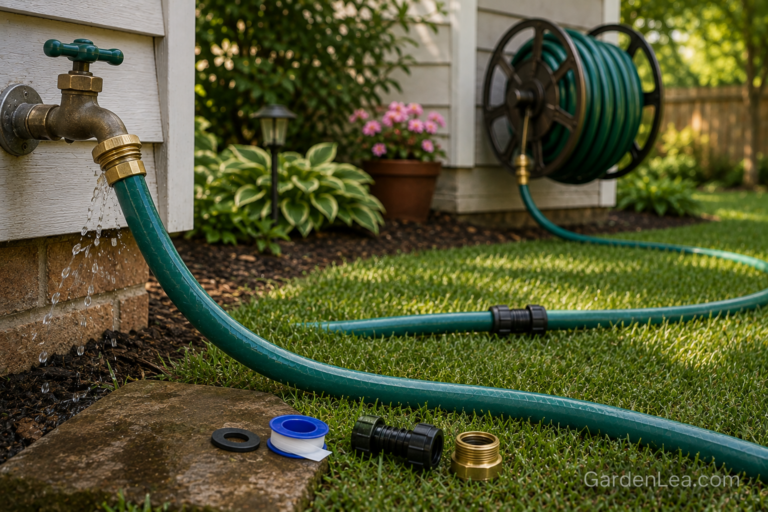
The coupling, where the hose threads onto the spigot or a nozzle, is usually brass or plastic, and this is one of the places where spending a little more genuinely pays off. Brass resists cracking, corrosion, and the wear of repeated attach/detach cycles far better than plastic, which is more prone to cracking in cold weather and stripping under overtightening. Plastic isn't a bad choice for occasional, gentle use, but if you're the kind of household that connects and disconnects attachments often, brass fittings will outlast plastic ones by a wide margin. We go deeper on this exact trade-off, including when plastic is genuinely fine, in brass vs. plastic garden hose fittings.
If you're also weighing whether a quick-connect adapter system is worth adding on top of your fitting choice, garden hose quick-connect fittings covers that as its own decision.
PSI ratings: why the number on the box rarely matters at home
Hoses are commonly rated for a maximum PSI (pounds per square inch) they can handle without failing. Typical U.S. municipal water pressure runs roughly 45 to 80 PSI, well under what almost any garden hose on the shelf is built to handle. Unless you're connecting to an unusually high-pressure source or running specialized equipment, the PSI number printed on the packaging is rarely the thing that decides whether a hose is right for you. Diameter, material, and fittings matter far more for a typical home setup.
Drinking-water safety: what to actually check
If kids, pets, or you yourself drink straight from the hose, this matters and deserves a straight answer rather than a marketing line. Some hose materials, particularly certain vinyl formulations, have historically raised concerns around lead and phthalates leaching into water that sits in a sun-heated hose. We're not going to name a specific certification or make a blanket safety claim about any material here, that's not something we can verify site-wide, and a page that invents a certification claim is worse than no page at all. What you can do: look for a hose explicitly labeled and sold as drinking-water-safe, rather than assuming any standard garden hose is fine for that use, and don't let water that's been sitting in a hot hose in the sun be the first thing anyone drinks.
Matching a hose to your specific use case
- Daily heavy use (frequent watering, larger yard): rubber or a heavier hybrid polymer, 5/8" or 3/4", brass fittings. This is where spending more up front pays for itself.
- Occasional or light use, tight storage: an expandable hose or a lighter reinforced vinyl in 1/2" or 5/8" is plenty.
- Cold climate: prioritize a material that stays flexible in the cold over one optimized purely for kink-resistance in warm weather; a stiff, cold hose creases where a pliable one flexes. Whatever you choose, how to store a garden hose for winter covers protecting it once the season ends.
- Kids or pets drinking from it: a hose explicitly labeled drinking-water-safe, per the section above.
Where to go next: the rest of this guide
This page covers the framework. If you already know your problem, here's where the deeper answer lives:
- Hose won't stop kinking? Why your garden hose keeps kinking
- Hose is leaking somewhere? How to fix a leaky garden hose, diagnosed by location
- Deciding on storage for the season or for winter: how to store a garden hose and best garden hose reels
- Comparing watering systems: soaker hose vs. drip irrigation
- Choosing a nozzle: best garden hose nozzles, a buying guide
- Fittings decisions: brass vs. plastic fittings and garden hose quick-connect fittings
FAQ
What's the best all-around garden hose diameter?
5/8" is the right default for most home yards, enough flow for a sprinkler or two without the extra weight and bulk of 3/4". Go smaller only for light container watering, and larger only for bigger properties or multiple simultaneous attachments.
Is a more expensive garden hose actually worth it?
Usually, if you use it often. The durability gap between cheap single-layer vinyl and a reinforced or rubber hose shows up within a season or two of regular use. For occasional light watering, a cheaper hose is a reasonable choice.
Do I need brass fittings, or is plastic fine?
Plastic is fine for occasional, gentle use. If you connect and disconnect attachments often, or you're in a cold climate, brass lasts substantially longer and resists cracking that plastic doesn't.
How do I know if a hose is safe to drink from?
Look for one explicitly labeled and sold as drinking-water-safe. Don't assume a standard garden hose is safe for drinking, and avoid drinking water that's been sitting in a hose left in the sun.
Should I just buy the longest hose available to be safe?
No. Longer hoses lose pressure over distance, weigh more, and have more surface area to kink or develop a leak. Measure the actual distance you need and buy close to that.
GardenLea publishes honest, practical home-and-garden guides. We don't sell hoses, so this framework is about matching the hose to your yard, not to any particular brand.