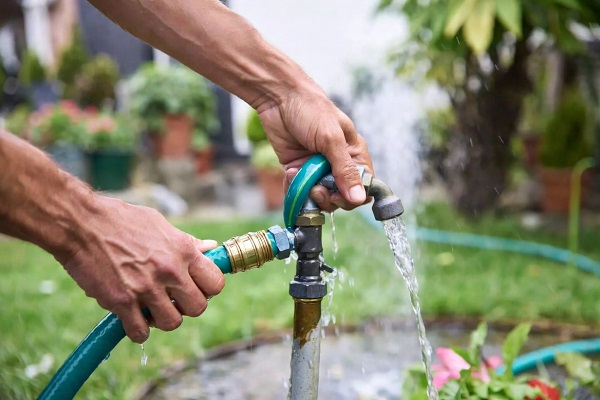
Garden Hose Quick-Connect Fittings: Are They Worth It?
Garden hose quick-connect fittings are worth it if you regularly swap between a nozzle, a sprinkler, and other attachments, or move a hose between multiple spigots, the push-to-connect design saves real time over threading and unthreading a standard coupling every time. They're less worth it if you keep one nozzle on one hose all season and rarely disconnect anything, since you're adding a connection point (and its own washer or O-ring) without much benefit. Either way, a well-made brass quick-connect set holds up better than a plastic one, the same trade-off that applies to standard hose fittings.
How a quick-connect system works
A quick-connect kit adds two parts: a fitting that screws onto your hose end (or your spigot) once and stays there, and a matching connector on each attachment (nozzle, sprinkler, wand) that snaps or clips onto it. Instead of threading a nozzle on and off by hand every time, you push it on and pull a release collar or lever to remove it. The threaded connection only happens once, when you first install the adapter; everything after that is a push-and-click.
What you actually gain: less thread wear, faster swaps
The genuine benefit is mechanical, not a specific savings figure. Every time you thread and unthread a standard coupling, you put wear on both sets of threads, and repeated over a season, that's a common way plastic threads eventually strip or a connection starts to seep. A quick-connect system reduces how often those threads are actually twisted, since the adapter goes on once and stays. The other real benefit is simple convenience: switching from a nozzle to a sprinkler takes a few seconds instead of unscrewing one and screwing on the other.
We won't repeat the specific dollar or water-savings figures some quick-connect sellers advertise, those are vendor claims tied to specific products and conditions we haven't verified. The mechanism above, less thread wear and faster swaps, is the honest, verifiable benefit.
What you're trading for it: one more connection, one more potential leak point
Every fitting you add to a hose line is another place a washer can wear out or a seal can fail. A quick-connect adapter is generally reliable, but it is still a joint with its own internal seal, and that's a genuine trade-off, not a reason to avoid the system, but a reason not to expect it to be maintenance-free forever. If a quick-connect joint starts to drip, the fix is the same logic as any other hose connection: check the internal washer or O-ring first, per our leaky garden hose guide, before assuming the whole adapter has failed.
Brass vs. plastic quick-connect bodies
Quick-connect adapters come in both brass and plastic, and the same durability trade-off that applies to any hose fitting applies here: brass resists cracking, corrosion, and wear from repeated use significantly better than plastic, especially in cold climates where plastic becomes brittle. Our brass vs. plastic garden hose fittings guide covers this comparison in full; the short version for quick-connects specifically is that the internal rubber seal matters as much as the body material, and either material's seal will eventually need replacing with normal use.
Compatibility: why "quick connect" isn't always universal
This is the catch that trips up first-time buyers. While standard garden hose threads are consistent across US manufacturers, quick-connect coupling designs are not universally standardized the same way, a connector from one brand doesn't always click securely into an adapter from a different brand. If you're building out a system with multiple attachments over time, buying adapters and connectors from the same product line (or ones explicitly stated as cross-compatible) avoids ending up with pieces that don't actually fit together.
Installing a quick-connect adapter
Adding a quick-connect system to an existing hose setup is a five-minute job, not a reason to buy a whole new hose.
- Screw the female adapter onto your spigot (or the male adapter onto your hose end, kits vary in which piece goes where, check the packaging). Hand-tighten snugly; overtightening can crush the internal washer the same way it would on a standard coupling.
- Screw the matching adapter onto each attachment you want to swap in and out, your nozzle, sprinkler, or wand.
- Push the two pieces together until you hear or feel a click. Give it a light tug to confirm it's seated; it shouldn't pull apart under normal use.
- To disconnect, pull back the release collar or lever (design varies by brand) and pull the pieces apart, no twisting required.
Once the adapters are installed, every future swap is push-and-click rather than thread-and-unthread, which is the entire point of the system.
Who should skip it
If you own one hose, one nozzle, water one area, and rarely disconnect anything, a quick-connect system adds cost and one more part to maintain for a convenience you won't use often. A standard threaded connection, checked occasionally for a worn washer, does the job just as well in that case. Quick-connect earns its keep specifically for households juggling multiple attachments, multiple spigots, or frequent hose-swapping tasks like car washing followed by garden watering.
If you haven't settled on the hose or the nozzle itself yet, our complete garden hose buying guide and nozzle buying guide cover those decisions first, a quick-connect system is worth adding on top of a hose and nozzle you've already chosen, not a substitute for choosing them well.
FAQ
Do quick-connect fittings leak more than standard threaded connections?
Not inherently, a well-made quick-connect with an intact internal seal is as reliable as a threaded connection. Like any fitting, the seal can wear out over years of use and will eventually need replacing.
Can I mix quick-connect brands?
Not reliably. Coupling designs vary between manufacturers, so a connector from one brand may not click securely into an adapter from another. Stick to one product line, or confirm explicit cross-compatibility before mixing.
Is brass or plastic better for a quick-connect fitting?
Brass lasts longer and resists cracking and corrosion better, especially in cold climates. Plastic is lighter and cheaper and reasonable for light, infrequent use.
Do I need quick-connect fittings if I only use one nozzle all season?
Probably not. The main benefit is faster swapping between multiple attachments or spigots; if you rarely disconnect anything, a standard threaded connection serves you just as well.
Will a quick-connect adapter fit my existing hose?
Adapters thread onto the standard garden hose thread used across US hoses, so fit at that first connection isn't usually the issue. The compatibility question is between different quick-connect brands' clip mechanisms, not between the adapter and your hose.
GardenLea publishes honest, practical home-and-garden guides. We don't sell fittings, so this is about whether the convenience is worth it for your setup, not a product recommendation.